Dans le monde de l’agroalimentaire, peu de produits sont aussi difficiles à manipuler que le simple biscuit. Sa structure délicate le rend facile à casser, pourtant, les consommateurs s'attendent à ce que chaque pièce soit parfaite et fraîche. C’est là que les machines modernes d’emballage de biscuits font une réelle différence en offrant une précision, cohérence, et une meilleure protection des produits.
Dans ce guide, vous apprendrez comment fonctionne chaque machine, quels avantages ils offrent, et comment choisir le bon système pour votre ligne de production. Que vous souhaitiez développer ou améliorer votre efficacité, tu trouveras clair, des informations pratiques pour soutenir des décisions plus intelligentes.
Qu'est-ce qu'une machine d'emballage de biscuits et pourquoi c'est important?

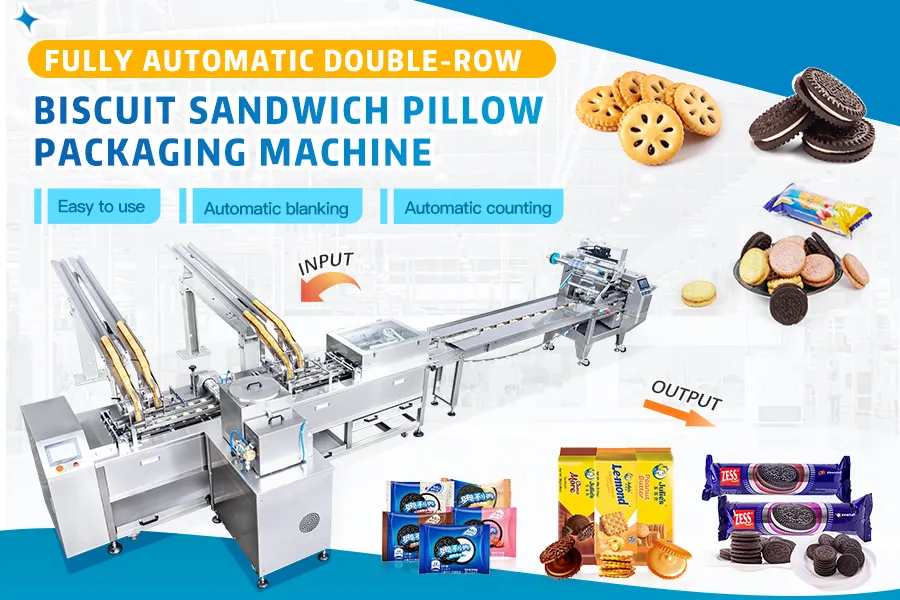
UN machine d'emballage de biscuits est un système automatisé spécialisé conçu pour compter avec précision, collationner, et envelopper les biscuits, craquelins, et produits de boulangerie similaires dans différents formats d'emballage. Ces machines gèrent tout, des paquets de collations individuels aux plateaux familiaux., assurer l’étanchéité à l’air et l’intégrité structurelle.
Pourquoi est-ce si important pour votre ligne de production?
Quand les biscuits sortent du four, ils sont au top de leur qualité. Cependant, l'humidité et l'air sont des ennemis immédiats. Un processus d'emballage manuel expose le produit à l'environnement pendant trop longtemps, conduisant à la douceur ou à la détérioration. Une machine automatisée scelle le produit presque instantanément. En outre, les réglementations modernes en matière de sécurité alimentaire sont strictes. L'automatisation minimise le contact humain, réduisant drastiquement les risques de contamination.
D'un point de vue opérationnel, le travail manuel ne peut pas suivre les rendements des fours modernes. Si votre four s'épuise 500 biscuits par minute, mais votre équipe d'emballage ne peut gérer que 200, vous avez un goulot d'étranglement qui tue la rentabilité. Une machine appropriée aligne votre capacité en aval avec votre production en amont.
Principaux types expliqués: Enveloppeuses de flux, Systèmes de pointe, et VFFS
1. Enveloppeuses de flux (Formage-Remplissage-Scellage horizontal – HFFS)
La flow wrapper est sans doute le type le plus courant dans l'industrie du biscuit.. Il fonctionne horizontalement, prendre des rouleaux de film plats, les former en un tube continu autour du produit, puis sceller l'emballage aux deux extrémités et le long du dos (le joint d'aileron).
- Objectif applicatif: Idéal pour les paquets de biscuits individuels, petites portions empilées, ou plateaux. Pensez aux biscuits en portion individuelle ou aux pochettes de craquelins.
- Avantage clé: Vitesse et efficacité exceptionnelles. De nombreuses flow wrappers modernes peuvent atteindre des vitesses de sortie dépassant 600 paquets par minute, surtout lorsqu'il est associé à des systèmes d'alimentation automatisés. Le colis produit est généralement un pochette style oreiller, qui est hautement protecteur et utilise un minimum de film.
2. Systèmes d'emballage à la pointe de la technologie (Emballages de limaces)
Ces systèmes spécialisés sont conçus pour emballer des biscuits “sur le fil”-c'est, empilés verticalement sur le côté dans un “limace” ou une rangée.
- Objectif applicatif: Idéal pour emballer des portions familiales, comme des paquets rectangulaires ou carrés de sablés ou de digestifs qui tiennent debout dans l'emballage fini.
- Avantage clé: Crée un compact, bloc rigide de produit, minimiser les mouvements et les cassures à l'intérieur du colis. Le processus consiste généralement à rassembler un décompte précis, puis à emballer l'ensemble du groupe., souvent avec un pli et un sceau attrayants. C'est la référence en matière de haut de gamme, formats de biscuits traditionnels.
3. Formage-Remplissage-Scellage Vertical (VFFS)
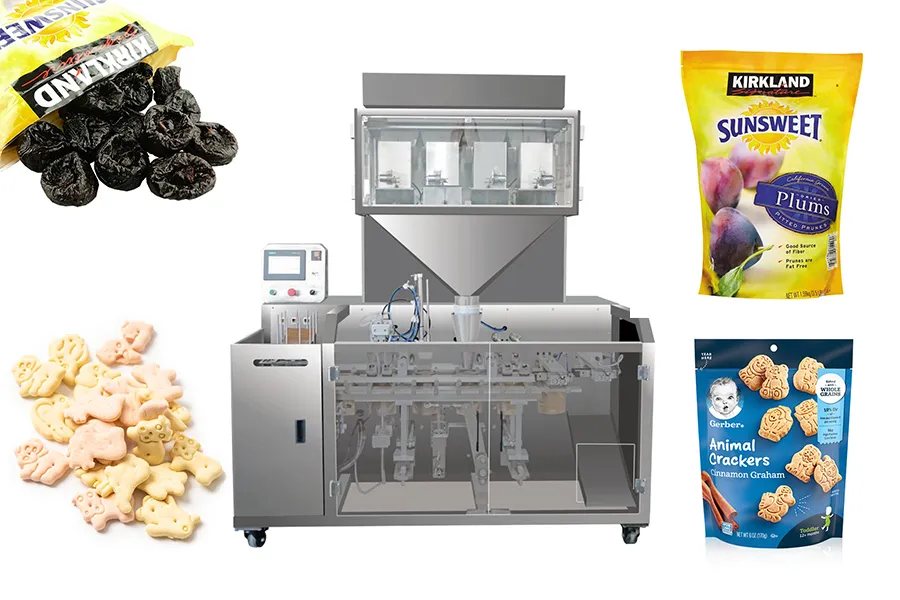
Bien que moins courant pour les biscuits traditionnels, la machine VFFS est indispensable pour les petits, produits en vrac comme des mini-crackers, miettes de biscuits, ou des formes fantaisie conditionnées en sachet.
- Objectif applicatif: Création de sachets ou de sacs scellés dans lesquels le produit tombe du haut dans le tube de film se formant verticalement.
- Avantage clé: Excellent pour les tailles de sacs flexibles et l'intégration de peseuses multi-têtes pour garantir un remplissage volumétrique ou pondéral précis des produits en vrac. Il produit une stabilité, sac bien fermé (souvent une pochette à soufflet ou debout) rapidement et efficacement.
| Fonctionnalité | Enveloppeuse de flux (HFFS) | Système de pointe | VFFS |
| Format du produit | Individuel, petites piles, plateaux | Limaces/piles verticales (par ex., packs familiaux) | Lâche, remplissage en vrac (par ex., miettes, mini-crackers) |
| Potentiel de vitesse | Très élevé (300–600+ paquets/min) | Haut (100–300 balles/min) | Haut (60–150 sacs/min, en fonction du volume) |
| Style de paquet | Pack d'oreillers, extrémités scellées | Suremballage rectangulaire, paquet serré | Poche, sac, sac debout |
Comment fonctionne une machine d'emballage de biscuits?
Alors que les flow wrappers et les systèmes sur bord diffèrent en termes d'alimentation, la logique de base suit un chemin similaire. Décomposons le cycle de vie d'un emballage sur une emballeuse à haute vitesse typique.
Phase 1: L'alimentation
Le processus commence par le convoyeur d'alimentation. Ici, pattes (petits poussoirs en plastique) ou des ceintures intelligentes espacent les biscuits. Cet espacement est crucial. Si l'espacement est désactivé, la machine coupe le produit au lieu du film. Nous appelons cela “pas.” Les machines modernes utilisent des photocellules (capteurs) pour détecter automatiquement la position du produit.
Phase 2: Formation de film
Au fur et à mesure que le produit avance, le film se déroule à partir d'une bobine au-dessus ou en dessous. Il passe sur un “boîte de formage” ou “formant épaule.” Ce collier métallique façonne le film plat en tube autour des biscuits en mouvement. Le contrôle de la tension est ici vital; trop serré, et tu écrases le biscuit; trop lâche, et le colis a l'air bâclé.
Phase 3: Étanchéité longitudinale
Une fois que le film forme un tube, les bords doivent être joints. Des roues chauffées ou des barres de scellage courent le long du fond (ou en haut) du colis, créant le “joint d'aileron.” Cela fournit le joint hermétique qui empêche l'air de pénétrer.
Phase 4: Scellement et découpe des extrémités
Enfin, le tube atteint le “mâchoires.” Ce sont des barres métalliques chauffées et rotatives qui se fixent entre les produits. Ils effectuent deux actions simultanément: ils scellent le bord arrière d'un paquet et le bord avant du suivant, tandis qu'un couteau les coupe en morceaux. Utilisation de machines à grande vitesse “mâchoires rotatives” qui tourne continuellement, alors que plus lent, les applications hermétiques pourraient utiliser “mouvement de la boîte” mâchoires pour un temps de séjour plus long (temps de contact).
Phase 5: La décharge
Une fois que le couteau sépare le paquet, le processus n'est pas tout à fait terminé. L'unité finie tombe sur le tapis roulant de déchargement, ce qui l'éloigne des mâchoires de scellement. Cette étape est critique pour l’intégration du contrôle qualité. Souvent, nous installons des trieuses pondérales ou des détecteurs de métaux juste à ce point de sortie pour garantir que chaque paquet quittant la ligne répond aux spécifications de poids et aux normes de sécurité avant d'être mis en boîte.
Principaux avantages de l'utilisation d'une machine d'emballage de biscuits
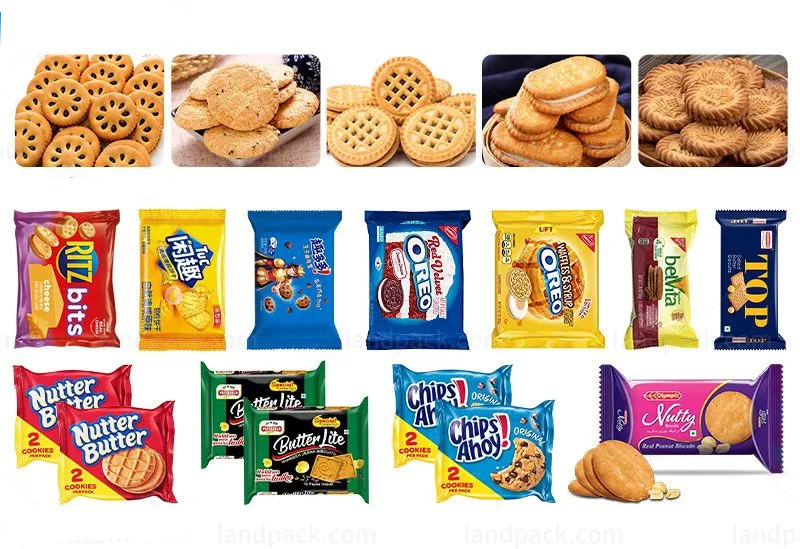
Débit optimisé et coûts de main-d'œuvre réduits
L'un des plus grands avantages est la rapidité. Quand on passe du travail manuel à l’automatisation, votre sortie peut passer 400% ou plus. Un travailleur peut emballer 20 à 30 paquets par minute, tandis qu'une machine d'emballage de biscuits de milieu de gamme peut atteindre 150 à 200 paquets par minute avec une précision constante. Cette augmentation réduit votre coût par paquet et rend l'ensemble de votre ligne plus rentable..
Meilleure durée de conservation et sécurité alimentaire renforcée
Le scellage automatisé crée un joint étanche, étanchéité fiable à chaque fois. Ce joint bloque l'humidité, poussière, et l'oxygène, trois facteurs majeurs qui font perdre aux biscuits leur texture et leur saveur.. Si vous utilisez la technologie MAP, le produit reste frais encore plus longtemps. Avec automatisation, vous obtenez une sécurité et une cohérence reproductibles que vous ne pouvez pas obtenir à la main, donner à votre marque une protection plus forte.
Moins de dommages aux produits et moins de déchets
Les biscuits sont fragiles, et la manipulation manuelle entraîne souvent des casses. Les systèmes d'alimentation automatisés utilisent des mouvements fluides et contrôlés, réduisant les chocs et les frottements. Cela signifie moins de biscuits cassés et un rendement vendable plus élevé.. Vous économisez également du film d'emballage car la machine distribue le film avec précision, réduisant les déchets de matériaux de 5 à 10 % par rapport aux systèmes plus anciens.
Présentation plus forte et meilleur attrait de la marque
Faire le ménage, les packs uniformes se démarquent sur les étagères. Les machines automatisées détiennent la taille, forme, et la qualité du joint reste constante d'un pack à l'autre. Par conséquent, vos produits semblent haut de gamme et dignes de confiance. Pour les emballages sur chant, le format serré « slug » améliore à la fois la résistance et l'apparence, aider vos colis à survivre au transport et à rester parfaits lorsque les clients les récupèrent.
Comment choisir la bonne machine d'emballage de biscuits
La sélection de la machine appropriée est une décision stratégique qui affecte vos opérations pendant des années. Cela nécessite une évaluation détaillée de votre gamme de produits actuelle et de vos plans de croissance futurs..
1. Évaluer les spécifications et le volume du produit
- Dimensions du produit: Vos biscuits ont-ils une taille uniforme, ou en avez-vous plusieurs UGSs? Une machine très flexible capable de gérer une large gamme de largeurs et de longueurs avec un minimum temps de changement est essentiel pour les fabricants proposant des portefeuilles de produits diversifiés.
- Cible de débit: Déterminez vos packs requis par minute (ppm). Si tu as besoin 200 PPM de manière cohérente, vous devez acheter une machine conçue pour au moins 250 PPM pour assurer la marge et la stabilité. Une capacité excessive est souvent un investissement judicieux à long terme.
- Fragilité du produit: Pour les objets extrêmement fragiles, recherchez spécifiquement les machines équipées d'alimentateurs à manipulation douce (par ex., courroies dentées servocommandées) et systèmes de regroupement à mouvement doux.
2. Évaluer le style et le matériel d'emballage requis
Si vous produisez principalement à taille familiale, packs debout, un système On-Edge est obligatoire. Si vous vous concentrez sur les paquets de collations en portions individuelles, un Flow Wrapper à grande vitesse est le bon choix. En outre, pensez à votre film d'emballage. Si vous envisagez d'utiliser des produits respectueux de l'environnement, compostable, ou films sur papier, s'assurer que la machine est équipée de technologies d'étanchéité avancées (comme le scellement par ultrasons) qui sont compatibles avec ces matériaux, car les thermoscellages traditionnels peuvent être moins efficaces.
3. Focus sur l'automatisation et l'intégration
Un moderne, la machine haut de gamme doit s'intégrer de manière transparente avec l'amont (four, convoyeur de refroidissement) et en aval (emballeur de caisses, palettiseur) équipement.
- Contrôles: Recherchez une interface homme-machine intuitive (IHM) et contrôle avancé des servomoteurs dans tout le système. Les servomoteurs offrent un contrôle précis de la vitesse, entretien minimal, et permettent des changements de produits en fonction des recettes en quelques minutes, pas les heures – un facteur crucial pour la flexibilité de la production.
- Sanitaire: Puisque tu es dans le industrie alimentaire, la conception de la machine doit être conforme aux normes sanitaires. Recherchez une conception en porte-à-faux ou avec des pièces facilement accessibles pour un lavage en profondeur et un retrait des miettes., réduire le risque d’hébergement bactérien.
Conseils d’entretien et de nettoyage pour prolonger la durée de vie de votre machine
Une machine d'emballage de biscuits bien entretenue reste rapide, écurie, et rentable. Quand vous prenez soin de votre matériel, vous réduisez les temps d'arrêt et protégez votre investissement. Une routine claire vous aide à maintenir le fonctionnement optimal de la machine.
Nettoyage quotidien et hebdomadaire
- Enlever les miettes et les restes de film
Les biscuits créent toujours des miettes, et ils ont tendance à se rassembler autour des convoyeurs, poches, et la zone d'étanchéité. Si tu ne les nettoies pas chaque jour, ils augmentent la friction et affectent la qualité du joint. Utilisez de l'air comprimé doucement ou comptez sur un aspirateur industriel pour garder la zone propre. - Nettoyer les mâchoires de scellement
Les revêtements de film et l'encre peuvent laisser des résidus sur les mâchoires de scellage. Même une fine couche affecte le transfert de chaleur et affaiblit le joint.. Un nettoyage quotidien rapide avec un produit non abrasif, un nettoyant approuvé aide à maintenir la solidité de vos joints et empêche le déchirement du film. - Vérifier la propreté du capteur
Les capteurs photo-yeux peuvent être obstrués par de fines poussières. Quand cela arrive, vous pouvez voir des erreurs de coupe ou d'alimentation. Essuyez régulièrement les capteurs afin qu'ils maintiennent une détection précise.
Entretien mensuel et trimestriel
- Suivez le calendrier de lubrification
Respecter strictement le plan de lubrification du fabricant pour toutes les chaînes, roulements, et composants mobiles. Utilisez uniquement le lubrifiant de qualité alimentaire spécifié dans le manuel de la machine. Une lubrification inappropriée ou de qualité non alimentaire présente un risque sérieux de contamination. - Vérifier la tension de la courroie et de la chaîne
Les composants desserrés provoquent des mouvements saccadés et réduisent la précision; des composants trop serrés provoquent une usure prématurée des roulements. La vérification et le réglage de la tension chaque mois aident votre machine à fonctionner sans problème et prolongent la durée de vie des composants.. - Inspecter les éléments chauffants et les thermocouples
Le système d'étanchéité dépend d'une chaleur constante. Assurez-vous que les barres ou roues de scellage chauffent uniformément et que les thermocouples fournissent des lectures de température précises.. Si la température fluctue de plus de 2°C, cela signifie souvent qu'un composant est sur le point de tomber en panne et doit être remplacé rapidement.
Réflexions finales
Une machine d'emballage de biscuits fait bien plus qu'emballer votre produit. Cela améliore la vitesse, protège la qualité, et donne à votre ligne de production un résultat stable et prévisible. Avec le bon équipement, vous pouvez réduire les déchets, améliorer la durée de conservation, et livrer un nettoyeur, pack plus cohérent à vos clients.
À CHLB, nous nous concentrons sur la construction de machines d'emballage de biscuits fiables, efficace, et facile à entretenir. En tant que fournisseur de confiance de machines d'emballage alimentaire, nous concevons nos solutions pour les fabricants qui souhaitent des performances constantes, forte qualité d'étanchéité, et valeur à long terme.
Prêt à moderniser votre ligne de production?
Contactez-nous aujourd'hui pour trouver la solution d'emballage de biscuits adaptée à votre entreprise.